If you ride in California, you’re riding under one of the most rider-specific legal frameworks in the country, and most of it works against you the moment you’re injured. California motorcycle accident law covers everything from whether lane splitting affects fault to how fast your filing deadline runs out, and insurance companies count on riders not knowing the details.
Bias against motorcyclists is real. Adjusters, witnesses, and sometimes jurors assume the rider was speeding, lane splitting recklessly, or simply “asking for it” by being on two wheels. None of that is a legal standard. It’s a prejudice your case has to overcome, and understanding the actual law is how you do it.
This guide breaks down the statutes, rules, and deadlines that govern motorcycle crashes in California, in plain language.
Why California Motorcycle Accident Law Works Differently Than You Think
Most people assume a motorcycle crash is treated exactly like a car accident under the law. In practice, it is, and it isn’t. The underlying legal principles, negligence, duty of care, and damages, are the same as any other personal injury claim. What’s different is how those principles get applied in practice.
Riders face unique defenses that car occupants rarely encounter: arguments about lane splitting, claims that visible riding gear or lack of a helmet contributed to injury severity, and an unspoken assumption from insurers that the motorcyclist was probably going too fast. A motorcycle accident lawyer who understands these patterns can anticipate them before the insurance company raises them.
Understanding California Motorcycle Accident Law: Lane Splitting and Fault
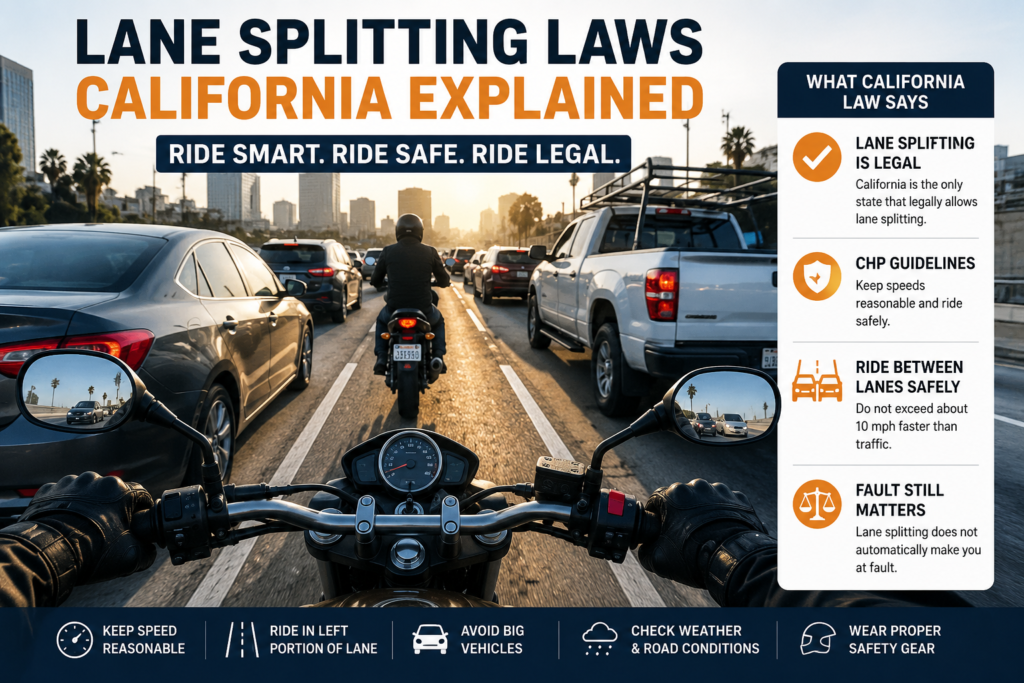
Lane splitting, riding between rows of stopped or slow-moving traffic in the same lane, is legal in California. It has been since 2017, when the legislature added Vehicle Code Section 21658.1 through Assembly Bill 51. California remains the only state that formally permits it.
The statute itself doesn’t set a speed limit or a speed-differential cap. Instead, it authorizes the California Highway Patrol to develop educational safety guidelines, in consultation with the DMV, Caltrans, and motorcycle safety organizations. Those guidelines aren’t law, but insurers and investigators use them as an informal benchmark for whether a rider was behaving reasonably.
Does Lane Splitting Automatically Make the Rider at Fault?
No. Because lane splitting is legal, a rider isn’t automatically liable just because they were doing it when a crash occurred. Fault still depends on what actually happened: speed, visibility, the other driver’s actions, and whether the lane-splitting maneuver itself was reasonable under the conditions.
That said, insurance adjusters routinely lead with the assumption that a splitting motorcyclist caused the crash. A rider who was splitting conservatively, at a modest speed with a small differential relative to traffic, is in a far stronger position than one who was weaving aggressively through tight gaps. If you were lane splitting when you were hit, our lane splitting accident lawyer San Diego page covers how these specific disputes typically play out.
California’s Helmet Law and How It Affects Your Claim
California requires every motorcycle rider and passenger, regardless of age, to wear a DOT-compliant helmet under Vehicle Code 27803. There’s no adult exemption. This is one of the more straightforward pieces of California motorcycle accident law, but it has real consequences for a claim if it wasn’t followed.
Not wearing a helmet doesn’t bar you from recovering compensation. California doesn’t have a law that automatically disqualifies an unhelmeted rider from suing. What it can do is give the insurer an argument that your injuries, particularly head or facial injuries, were worse than they would have been with a helmet. That argument can reduce your award under comparative negligence, but it has to be proven with medical evidence, not just assumed.
Comparative Negligence Under California Motorcycle Accident Law
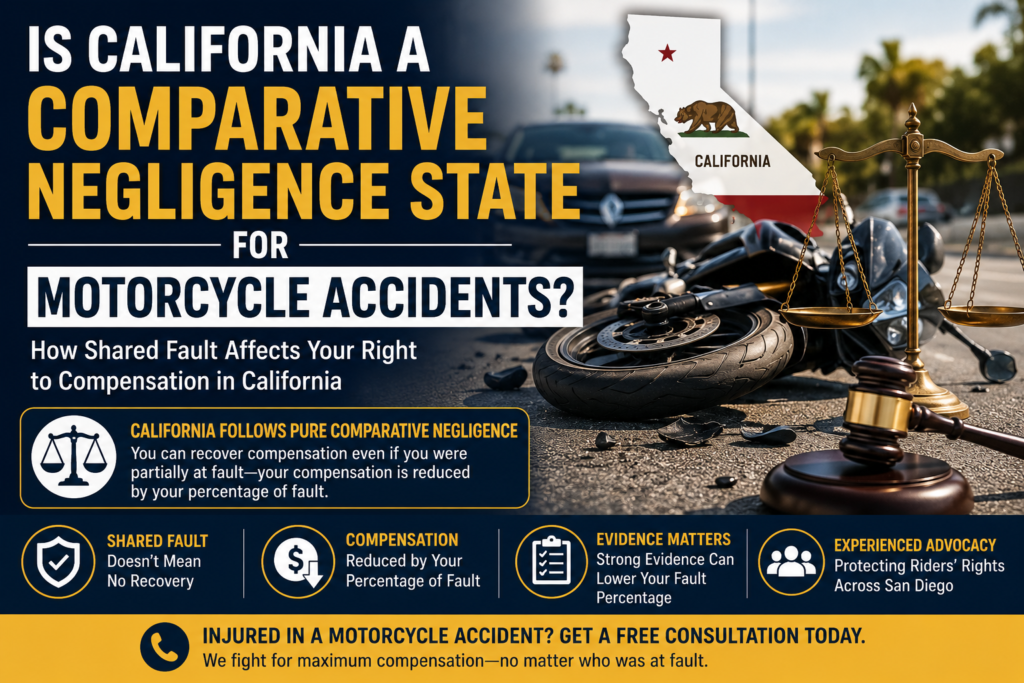
California follows a pure comparative negligence rule, established by the California Supreme Court in Li v. Yellow Cab Co. in 1975. Under this rule, an injured rider can still recover compensation even if they were partly at fault for the crash. The court or insurer simply reduces the award by the rider’s percentage of fault.
For example, if a jury found a rider 20% at fault for splitting lanes too aggressively and the other driver 80% at fault for an unsafe lane change, the rider would still recover 80% of their total damages. This is fundamentally different from states with contributory negligence rules, where any fault at all can bar recovery entirely.
This is also why insurance companies push so hard to assign even a small percentage of fault to the motorcyclist. Every percentage point shifted onto the rider directly reduces the payout. Knowing how to counter these arguments is a core part of building a strong claim, and it’s exactly the kind of dispute our motorcycle accident claim San Diego team handles regularly.
How Long Do You Have to File a Claim Under California Motorcycle Accident Law?
Timing is one of the least forgiving parts of California motorcycle accident law. Miss a deadline, and it doesn’t matter how clear the other driver’s fault was. The case is over before it starts.
The Two-Year Rule for Most Claims
Code of Civil Procedure Section 335.1 gives most injured riders two years from the date of the crash to file a personal injury lawsuit against the at-fault driver. The same two-year window applies to wrongful death claims, measured from the date of death rather than the date of the original crash.
Two years sounds generous, and for most riders working with an attorney, it is. The danger is in delay: putting off treatment, waiting to talk to a lawyer, or assuming the case will simply resolve itself. Evidence fades, witnesses move, and insurers get more aggressive the longer a claim sits open. Our breakdown of how long you have to file a motorcycle accident claim walks through the exceptions in more detail.
The Six-Month Rule for Government Entities
If a government entity is involved, a pothole-ridden city street, a defective traffic signal, a collision with a public bus, or a dangerous freeway condition maintained by Caltrans, the timeline shrinks dramatically. Government Code Section 911.2 requires a written claim to be filed with the responsible public agency within just six months of the crash, before any lawsuit can even be filed.
There’s no grace period for not knowing about this deadline. Riders hurt by an unmarked road hazard or a defect in a state highway need to move fast. If your crash involved a road condition rather than another driver, our motorcycle road hazard accident page explains how government claims typically work.
Exceptions for Minors and Other Tolling Rules
If the injured rider was under 18 at the time of the crash, the two-year clock generally doesn’t start running until their 18th birthday, under Code of Civil Procedure Section 352(a). The six-month government claim deadline, however, still applies even when the injured party is a minor, which makes early legal advice especially important in those cases.
Who Can Be Held Liable After a Motorcycle Accident in California?
California motorcycle accident law doesn’t limit liability to just the other driver. Depending on how the crash happened, several parties could share responsibility.
The At-Fault Driver
Most claims start here. Left-turn crashes, rear-end collisions, and unsafe lane changes by drivers who “didn’t see” the motorcycle are some of the most common scenarios riders face.
An Employer Through Vicarious Liability
If the at-fault driver was working at the time, delivering goods, driving for a rideshare company, or operating a commercial vehicle, their employer may share liability. This is especially relevant in crashes involving commercial trucks, where the trucking company’s policies and driver oversight often come into play.
A Government Entity
As discussed above, dangerous road conditions, missing signage, or defective traffic controls can shift liability onto a city, county, or state agency, subject to that strict six-month claim deadline.
A Manufacturer
When a crash is caused or worsened by a defective part, a failed brake system, a tire blowout, a faulty kickstand, the manufacturer can be held liable under product liability law rather than ordinary negligence. Our defective motorcycle parts attorney page covers this distinct legal theory.
What Compensation Does California Motorcycle Accident Law Allow?
Once liability is established, California motorcycle accident law allows injured riders to pursue compensation for the full scope of their losses, not just the obvious medical bills.
- Medical expenses, including emergency care, surgery, rehabilitation, and future treatment supported by medical documentation.
- Lost income, both wages already missed and reduced future earning capacity for riders left with lasting impairments.
- Pain and suffering, accounting for physical pain and the psychological toll of a serious crash.
- Property damage, covering repair or replacement of the motorcycle and gear.
- Wrongful death damages, when a crash proves fatal, available to surviving spouses, children, and other qualifying family members.
If a loved one was killed in a crash, the legal process and the damages available are different from a standard injury claim. Our wrongful death motorcycle accident page explains what surviving family members are entitled to pursue. For riders trying to understand what their case might realistically be worth, our motorcycle accident settlement page is a useful starting point.
Common Mistakes That Hurt a Claim Under California Motorcycle Accident Law
We see the same avoidable errors again and again, and they almost always benefit the insurance company at the rider’s expense.
- Admitting fault at the scene. Saying “I didn’t see them either” or apologizing instinctively can be used against you later, even if it isn’t an accurate statement of fault.
- Skipping the police report. Without an official collision report, insurers have an easier time disputing what happened.
- Giving a recorded statement to the other driver’s insurer. Adjusters are trained to ask questions designed to shift blame onto the motorcyclist, including questions about lane splitting and speed.
- Posting about the crash on social media. Photos or comments suggesting a quick recovery can undercut a legitimate injury claim.
- Waiting too long to get medical care or legal advice. Gaps in treatment and missed deadlines are two of the most common ways strong cases get weakened.
If you’ve already made one of these mistakes, it doesn’t necessarily sink your case, but it does make experienced representation more important. Our motorcycle accident insurance claim page goes into more detail on how adjusters approach these cases.
How to File a Claim Under California Motorcycle Accident Law
The process is fairly consistent across most motorcycle crashes, though the specifics shift depending on who’s liable.
- Get medical care immediately, even if injuries seem minor at first. Documentation created close to the crash date carries the most weight later.
- Report the crash to law enforcement and obtain a copy of the collision report.
- Preserve evidence, including photos of the scene, your bike, your gear, and any visible injuries, along with witness contact information.
- Identify every potentially liable party, since government and product liability claims carry different deadlines than a standard driver-on-driver case.
- Consult an attorney before speaking with insurers in detail about fault or injuries.
- File the claim or lawsuit within the applicable deadline, whether that’s the standard two years or the six-month government claim window.
Our what to do after a motorcycle accident guide walks through these first steps in more depth, and you can start a motorcycle accident lawsuit review whenever you’re ready to move forward.
Why Local Knowledge of California Motorcycle Accident Law Matters in San Diego
State law sets the baseline, but how a claim actually plays out depends heavily on local courts, local insurers, and local road conditions. Freeway interchanges, intersection design, and even jury tendencies vary across San Diego County.
Whether your crash happened in Downtown San Diego, Chula Vista, or El Cajon, working with an attorney who knows the local terrain and the local insurance adjusters can make a meaningful difference in how your claim is valued and handled.
Frequently Asked Questions
What does California motorcycle accident law say about lane splitting fault?
Lane splitting is legal in California under Vehicle Code 21658.1, so a rider isn’t automatically at fault for splitting when a crash occurs. Fault still depends on the specific facts, including speed, visibility, and the other driver’s actions.
Can I still recover compensation if I wasn’t wearing a helmet?
Yes. Not wearing a helmet doesn’t bar a claim, but it can be used to argue that your injuries were more severe than they would have been with one, which may reduce your award under comparative negligence.
How does fault get divided if both the rider and driver made mistakes?
California motorcycle accident law uses pure comparative negligence, meaning you can still recover compensation even if you were partly at fault. Your award is simply reduced by your percentage of responsibility for the crash.
What’s the deadline to file a motorcycle accident lawsuit in California?
Generally two years from the date of the crash under Code of Civil Procedure 335.1. If a government entity is involved, you have only six months to file an administrative claim first.
Can I sue if a road defect caused my motorcycle crash?
Possibly, if a city, county, or state agency failed to maintain the road safely. These claims require a government claim filed within six months, far shorter than the standard two-year window.
Do I need a lawyer to handle a motorcycle accident claim?
It’s not legally required, but insurers routinely use rider bias and technical defenses to minimize payouts. An attorney familiar with how these claims are evaluated can significantly change the outcome.
Will hiring a lawyer cost anything upfront?
No. Most California motorcycle accident attorneys, including our firm, work on contingency, meaning there’s no fee unless we recover compensation for you.
Talk to an Attorney Who Knows California Motorcycle Accident Law
Riding comes with enough risk on the road. You shouldn’t have to fight an uphill legal battle on top of recovering from a crash. Understanding California motorcycle accident law, from lane splitting and helmet rules to comparative fault and filing deadlines, is the first step toward protecting your claim.
Insurance companies know the law too, and they use it to minimize what they pay riders every day. Don’t navigate a lane-splitting dispute, a government claim deadline, or a lowball settlement offer without someone who handles these cases regularly.
Schedule a free motorcycle accident consultation today. There’s no fee unless we win, and no obligation to find out where your case stands.
Visit our homepage to learn more about how we help injured riders throughout San Diego County understand their rights and recover full compensation after a crash.