Search “is lane splitting legal in California” and you’ll get five different answers from five different forums, half of them outdated, some of them just wrong. So here are lane splitting laws California explained the way they actually work, not the way a Reddit thread from 2015 remembers them.
Short version: yes, it’s legal. Has been since 2017. But “legal” and “risk-free” are two very different things, especially if you’re ever in a crash while doing it. The law that makes lane splitting legal is short. The practical consequences of doing it badly, or being blamed for a crash you didn’t cause, are not.
Let’s get into what the statute actually says, what it doesn’t say, and what happens to your case if a driver hits you while you’re between lanes.
So, Is Lane Splitting Actually Legal in California?
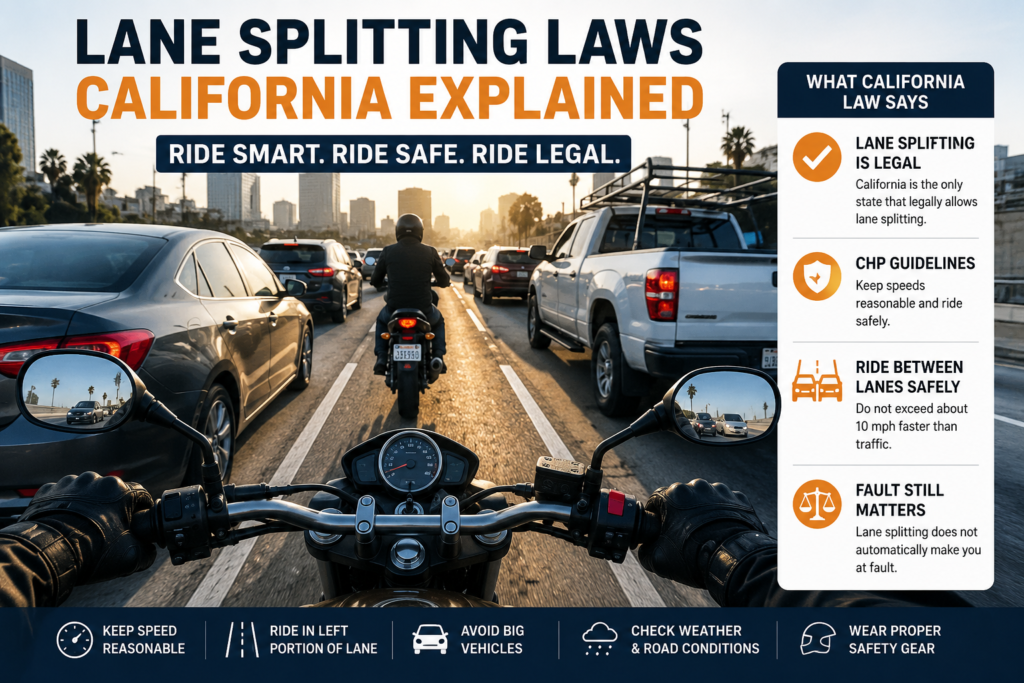
Yes. California is the only state in the country that formally allows it. Riders here have always done it informally, but for decades it existed in a kind of legal gray zone, tolerated, not codified. That changed with Assembly Bill 51, which added Vehicle Code Section 21658.1 to the books, effective January 1, 2017.
The statute defines lane splitting as riding a two-wheeled motorcycle between rows of stopped or moving vehicles in the same lane, on divided or undivided roads. That’s it. That’s the whole legal definition. What the statute notably doesn’t do is set a speed limit, a maximum speed differential, or any numeric threshold at all. A lot of websites will tell you there’s a “10 mph rule” written into California law. There isn’t. That number comes from somewhere else, which we’ll get to.
What the Statute Actually Does
Beyond defining the practice, the law gives the California Highway Patrol authority to develop educational safety guidelines around it, in coordination with the DMV, Caltrans, and motorcycle safety groups. It’s a narrow law. It legalizes the behavior and hands the safety messaging to CHP. Nothing more.
Lane Splitting Laws California Explained: Where the CHP Guidelines Actually Come From
Here’s where most articles online get sloppy. They’ll cite a “California law” requiring a maximum 10 mph speed differential. That’s not a law. It’s a recommendation published by the California Highway Patrol as part of its motorcyclist safety guidance, and it has no force of statute behind it.
That distinction matters more than it sounds like it should. You can’t get a ticket for exceeding a 10 mph differential, because no such legal limit exists. What you can do is hand an insurance adjuster a very convenient argument if you were splitting at a much higher differential than that when a crash happened. The guidelines function less like law and more like the standard everyone, including juries, ends up measuring your behavior against.
CHP’s published recommendations include:
- Avoid riding more than about 10 mph faster than the surrounding traffic.
- It’s generally safer to split between the far left lanes than anywhere else.
- Danger increases with overall speed, separate from the speed differential.
- Avoid splitting next to large vehicles like big rigs, buses, and motorhomes.
- Consider lane width, lighting, and weather before deciding to split at all.
None of this is enforceable in the way a speed limit sign is enforceable. But insurers know riders, and juries, treat it as the unofficial standard for “reasonable” lane splitting. Split conservatively and within these guidelines, and you’re in a much stronger position if something goes wrong. Split like you’re trying to win a video game, and you’re handing the other side’s lawyer a gift.
Lane Splitting vs. Lane Filtering: They’re Not the Same Thing
You’ll see these terms used interchangeably online, and that’s part of why so much advice is muddled. They’re not actually the same maneuver.
Lane filtering, the version a handful of other states have started allowing, generally only applies when traffic is stopped or moving at a crawl. California’s law is broader. Section 21658.1 covers splitting between vehicles that are stopped or moving, which is a meaningfully wider allowance than what most lane-filtering states permit. It’s part of why California gets singled out as uniquely permissive, and also why riders moving to California from a filtering state sometimes misjudge what’s actually allowed here. The rule is more generous than they’re used to, not less.
What Drivers Are Required to Do Around Lane-Splitting Riders
This part rarely makes it into “lane splitting laws California explained” articles, and it’s worth knowing because it cuts the other direction. Drivers have obligations too.
It’s illegal for a driver to intentionally block or impede a motorcyclist in a way that could cause harm, the classic move where a frustrated driver nudges over to “teach the rider a lesson.” It’s also illegal to open a vehicle door specifically to impede a passing motorcyclist. CHP guidance further encourages drivers in the far left lane to move toward the left side of their own lane when they see a rider approaching, giving extra clearance.
None of this means a driver is automatically liable just because a rider was splitting past them. But when a crash happens because a driver deliberately closed a gap, opened a door, or made an aggressive lane change without checking a mirror, that driver’s own legal obligations come into play, not just the rider’s.
How Lane Splitting Affects Fault After a Real Crash
This is the part that actually matters if you’ve been hit. Because lane splitting is legal, you are not automatically at fault for a crash just because you were doing it. People assume otherwise constantly, including some drivers who’ll tell a police officer at the scene that the motorcyclist “shouldn’t have been splitting” as if that settles the matter. It doesn’t.
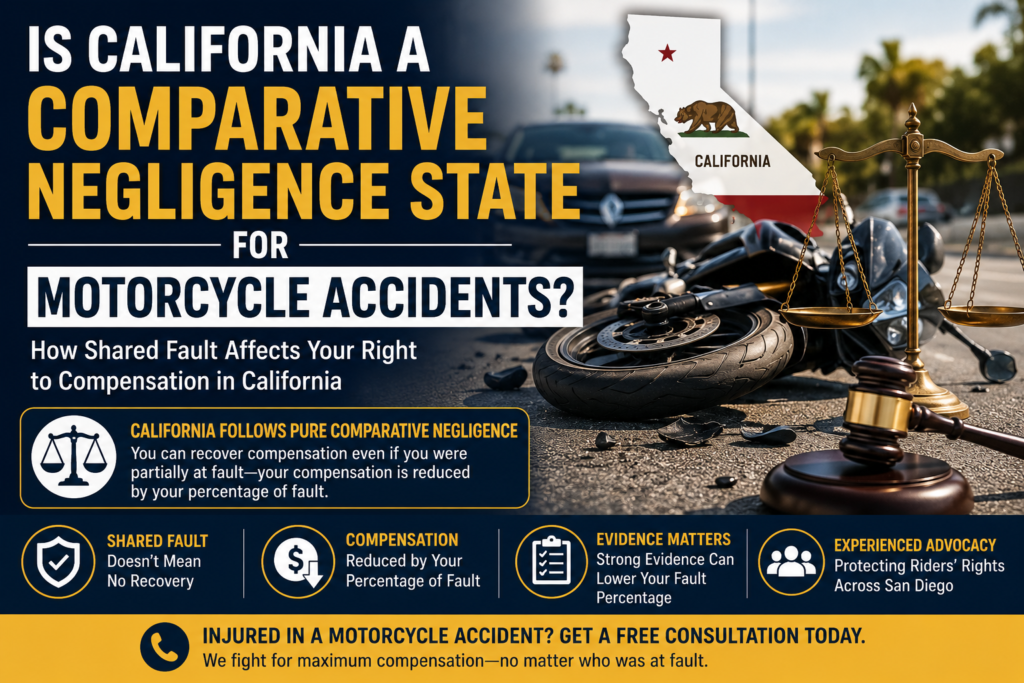
California applies pure comparative negligence to every crash, lane-splitting or not. Fault gets divided based on what everyone actually did wrong, and you can still recover compensation even if you’re found partially responsible. Your award just gets reduced by your share of the fault.
What Insurance Adjusters Actually Look At
If you were splitting when a driver hit you, expect the conversation to start with questions about your speed relative to traffic, not about what the driver was doing. That’s strategic. The faster they can establish that you were riding well outside CHP’s recommended differential, the easier it is to shift blame your way.
What actually gets evaluated:
- Your estimated speed compared to the flow of traffic at the time
- Which lanes you were splitting between, and whether large vehicles were involved
- Visibility, weather, and lighting conditions
- Whether the other driver made an unsignaled lane change, opened a door, or otherwise created the hazard
- Witness statements, dashcam footage, or traffic camera angles, if any exist
This is exactly the kind of dispute that gets messy without documentation. If you were splitting lanes when you were hit, our lane splitting accident lawyer San Diego page goes deeper into how we build evidence around speed and conditions to counter the insurer’s default assumption.
Lane Splitting Laws California Explained: What to Do If You’re Hit While Splitting
The instinct after a crash, splitting or not, is to start explaining yourself. Resist it. What you say at the scene, especially anything that sounds like an apology or an admission, tends to follow you straight into the claims file.
A few things matter more than anything you’ll say to the other driver:
Get medical attention even if you feel mostly fine, since adrenaline hides a lot in the first hour. Get the police report filed, with an actual officer at the scene rather than just an exchange of insurance cards. Take photos before anything gets moved, including the lane positions, the gap you were splitting through, and any skid marks. If there were witnesses nearby, get their information before they leave, because most people don’t think to volunteer it.
Our what to do after a motorcycle accident guide covers the broader version of this. If you’re past that stage and ready to talk through your options, our motorcycle accident claim San Diego page is the next step.
Myths That Keep Coming Up About California’s Lane Splitting Law
A handful of bad assumptions show up constantly, often repeated by drivers, sometimes even by riders who should know better.
“Lane splitting is illegal in California.” It isn’t. This one persists mostly because so many other states ban it outright, so people assume California must too.
“There’s a hard speed limit for lane splitting.” There isn’t a statutory one. The 10 mph figure is CHP guidance, not law, though it functions as the practical standard insurers and courts reach for.
“If I was splitting, I’m automatically at fault.” Not true, and not how comparative negligence works. Fault depends on the full picture of what happened, not just whether you were between lanes.
“My insurance won’t cover me if I was splitting.” Lane splitting is legal conduct. Insurers can’t deny coverage simply because you were doing something the law permits, though they will absolutely try to use it to argue you share some of the blame. If an adjuster has implied otherwise, our motorcycle accident insurance claim page explains how to push back.
Why San Diego Riders Run Into This Constantly
San Diego’s freeway grid practically guarantees this comes up. I-5, I-805, and SR-163 all turn into parking lots during rush hour, and lane splitting is how a lot of riders make their commute survivable instead of miserable. That also means a meaningful share of the motorcycle crashes we see have a lane-splitting angle to them somewhere, whether the rider was splitting, the other driver assumed they were, or both.
If your crash happened anywhere in the county, the analysis is the same regardless of zip code, but local familiarity still helps. Riders in Downtown San Diego, Chula Vista, and El Cajon deal with different freeway layouts and different local insurance patterns, and it helps to work with someone who already knows the terrain.
For the bigger legal picture beyond lane splitting specifically, comparative fault, filing deadlines, helmet rules, our guide to California motorcycle accident law covers the full framework your case sits inside.
Frequently Asked Questions
Is lane splitting actually legal in California?
Yes. Vehicle Code 21658.1 has formally defined and permitted it since January 1, 2017. California is the only state that allows it this broadly.
What’s the legal speed limit for lane splitting?
There isn’t one written into the statute. CHP recommends staying within about 10 mph of surrounding traffic, but that’s safety guidance, not an enforceable speed law.
Am I automatically at fault if I was lane splitting during a crash?
No. California’s comparative negligence rule means fault is based on everyone’s actual conduct, not just the fact that you were splitting lanes when the crash happened.
Can a driver legally block me from splitting past them?
No. Intentionally impeding a motorcyclist in a way that could cause harm is illegal, as is opening a car door specifically to block a passing rider.
Does splitting next to a big rig change anything legally?
It doesn’t change the law itself, but CHP specifically advises against splitting next to large vehicles because of reduced visibility and limited room to maneuver, which can affect how a crash gets evaluated.
Will my settlement be reduced just because I was splitting lanes?
Only if it’s shown you were splitting unreasonably and that contributed to the crash. Splitting conservatively and within CHP’s general guidance is a much harder target for an insurer to attack.
Do I need a lawyer if I was lane splitting when I got hit?
You don’t need one to file a claim, but insurers lean hard on lane-splitting bias to shift blame. Having someone who can document conditions and counter that narrative early tends to make a real difference in the outcome.
Talk to Someone Who Actually Knows This Law
We wrote this because so much of what’s online about lane splitting laws California explained is either outdated, oversimplified, or just wrong about what’s law versus what’s guidance. The distinction matters most exactly when you need it: after a crash, with an adjuster on the phone trying to pin the blame on you for doing something perfectly legal.
If you were lane splitting when you got hit, or a driver is claiming you were at fault simply because of where you were riding, don’t accept that framing without a fight.
Set up a free motorcycle accident consultation and we’ll walk through what actually happened, what the law says, and what your case is worth. No fee unless we win.
You can also visit our homepage to see how we help injured riders across San Diego County push back against lane-splitting bias and recover what they’re actually owed.