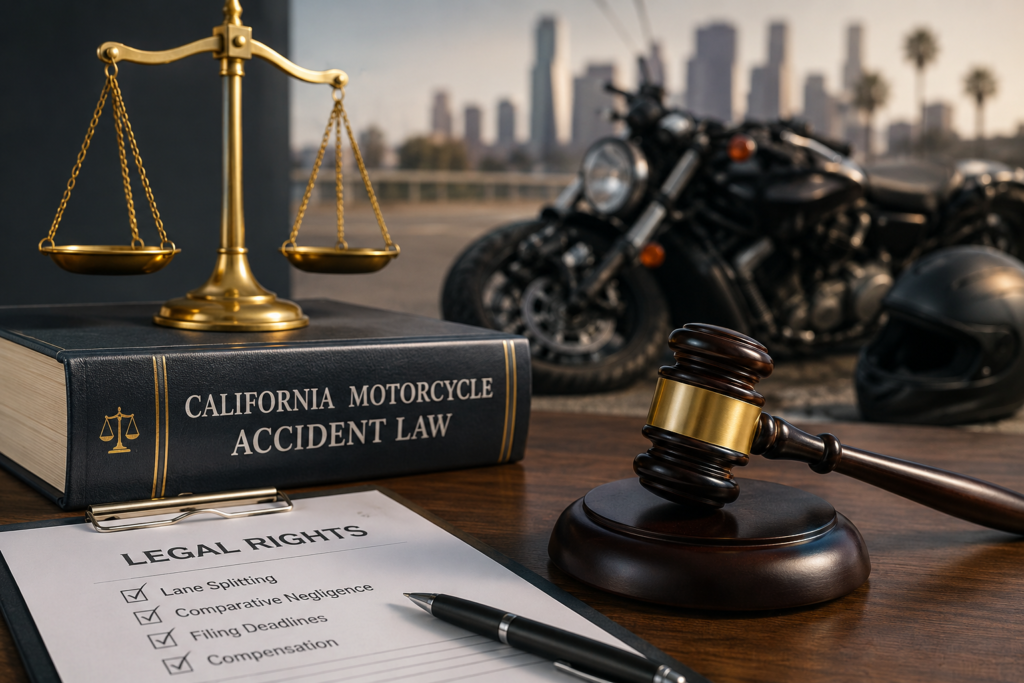
When a crash happens on a California road, the legal process that follows is not the same for everyone involved. Motorcycle accident vs car accident law California is a comparison that matters enormously — because the rules that govern how fault is determined, how insurance works, how injuries are valued, and how claims are fought are meaningfully different depending on whether the vehicle was a motorcycle or a car. Riders who don’t understand those differences often make decisions that cost them money they were legally entitled to recover.
California has specific statutes, insurance rules, and legal standards that apply differently to motorcyclists and car drivers. Some of those differences favor riders. Others create additional hurdles that riders have to clear before they can recover full compensation. This guide walks through every major legal distinction between motorcycle and car accident claims in California so you know exactly where you stand and what to expect if you have been hurt on the road.
Whether you are a rider who was injured by a negligent driver, or a motorist trying to understand how a crash involving a motorcycle is handled differently under California law, this is the guide that answers those questions clearly. For an overview of the broader legal framework governing motorcycle crashes in the state, our California motorcycle accident law page provides foundational context alongside this comparison.
Motorcycle Accident vs Car Accident Law California — What Makes Them Different?
At the surface level, a motorcycle accident and a car accident are handled under the same general personal injury framework in California. Negligence must be established, damages must be documented, and fault is divided using California’s pure comparative negligence standard. But the similarities largely end there.
The differences between motorcycle accident vs car accident law California stem from several distinct areas:
- Separate licensing and registration requirements for motorcyclists
- Different minimum insurance requirements
- Motorcycle-specific traffic laws that do not apply to cars
- Helmet laws that have no equivalent for car occupants
- The physical vulnerability of riders compared to enclosed vehicle occupants
- The bias motorcyclists frequently encounter from insurers and juries
- The way injury severity and damages are calculated based on the nature of motorcycle crashes
Each of these differences shapes how a claim is built, negotiated, and ultimately resolved. A rider who approaches their injury claim the same way a car accident victim would is starting at a disadvantage before the first conversation with an adjuster.
How California Law Treats Motorcyclists Differently From Car Drivers
California maintains a separate licensing system for motorcycle operators. Under California DMV regulations, riders must obtain a motorcycle license endorsement or a standalone Class M1 or M2 license in addition to any standard driver’s license. This requirement exists because operating a motorcycle requires a distinct skill set — balance, throttle control, braking technique, and hazard awareness — that is not tested in a standard vehicle licensing exam.
This separate licensing requirement has a direct legal implication in accident claims. If a rider was operating a motorcycle without a valid motorcycle endorsement at the time of a crash, insurers and defense attorneys will raise that fact as evidence of negligence. It does not automatically bar recovery under California’s comparative negligence rule, but it becomes ammunition for a fault argument that can reduce what the rider recovers.
Car drivers face no equivalent requirement. A standard California driver’s license is all that is needed to operate most passenger vehicles, and driving without a valid license — while technically a violation — is not treated with the same severity in personal injury litigation as unlicensed motorcycle operation.
Registration and Equipment Standards
Motorcycles must meet California’s equipment standards for lighting, mirrors, exhaust systems, and handlebar height, among other specifications. Non-compliant modifications — aftermarket exhaust systems, altered handlebars, non-standard lighting — can be raised as contributing factors in a crash claim, particularly when an insurer is looking for comparative fault arguments to reduce liability. Car owners face similar registration and equipment requirements, but the range of modifications that create legal exposure in a crash claim is narrower for passenger vehicles than for motorcycles.
Insurance Requirements — Motorcycles vs Cars in California
California requires all motor vehicles operated on public roads to carry minimum liability insurance. But the minimum requirements and the available coverage options differ between motorcycles and cars in ways that affect injured victims significantly.
Minimum Liability Coverage
Both motorcycle and car owners in California must carry minimum liability insurance that covers:
- $15,000 for injury or death to one person
- $30,000 for injury or death to more than one person
- $5,000 for property damage
These minimums are the same for both vehicle types. However, what differs is the availability and uptake of optional coverage types — and this gap matters enormously to injured riders.
Uninsured and Underinsured Motorist Coverage
Uninsured motorist coverage and underinsured motorist coverage protect you when the at-fault driver either has no insurance or carries limits that are insufficient to cover your actual damages. For car accident victims, this coverage is common and frequently carries limits that match or exceed the primary policy.
For motorcycle riders, uninsured and underinsured motorist coverage is less consistently purchased — and when riders are injured by an uninsured driver, that gap in their own policy can leave them with no meaningful source of compensation. Given that motorcycle accident injuries tend to be significantly more severe than car accident injuries, the financial consequence of that coverage gap is proportionally larger. This is one of the most important insurance distinctions in the motorcycle accident vs car accident law California comparison, and it is discussed in more detail on our motorcycle accident insurance claim page.
Medical Payments Coverage
Medical payments coverage — often called MedPay — covers treatment costs regardless of fault. For car accident victims, MedPay is a standard optional add-on that many drivers carry. For motorcyclists, this coverage is available but less frequently included, leaving many riders responsible for covering their immediate medical costs out of pocket while their liability claim is still being negotiated.
Fault and Liability — How It Works for Each
California uses a pure comparative negligence standard for both motorcycle and car accident claims. Under this rule, fault is divided proportionally among all parties whose actions contributed to the crash, and each party’s damages are reduced by their assigned percentage of fault. A rider found 30% at fault recovers 70% of their total damages. A car driver found 30% at fault does the same.
The standard is the same. The way it is applied in practice is not.
The Bias Problem in Motorcycle Claims
Motorcycle riders face a level of implicit bias in fault assessments that car drivers almost never encounter. Insurance adjusters, police officers, and even jurors sometimes arrive at a motorcycle accident with a pre-formed assumption that the rider must have been doing something reckless — speeding, weaving, taking unnecessary risks — simply because they were on two wheels instead of four.
This bias is not supported by crash data, but it is real and it has a measurable impact on how comparative fault percentages are initially assigned. A car driver involved in an identical crash scenario will typically receive a lower initial fault assignment from an insurer than a motorcyclist in the same situation, all else being equal. Challenging that bias requires evidence, documentation, and an advocate who understands the pattern and how to counter it effectively.
Presumption of Fault
In some crash configurations — particularly rear-end collisions — car drivers benefit from a strong legal presumption that the following vehicle is at fault. Motorcyclists involved in rear-end collisions enjoy the same presumption when they are the vehicle being struck, but they encounter a different dynamic when the configuration is less clear-cut. A motorcycle that rear-ends a car, for example, is more likely to face an aggressive comparative fault argument based on following distance and reaction time than a car driver in the same position, partly because of the bias issue and partly because motorcycles are perceived as more maneuverable and therefore more capable of avoiding a collision.
Comparative Negligence and Motorcycle Accidents
Because comparative negligence is central to how both types of claims are resolved — and because it operates differently in practice for motorcycle riders — it deserves its own focused discussion in this motorcycle accident vs car accident law California comparison.
For car accident victims, comparative negligence arguments tend to focus on a narrower set of behaviors: speed, signal use, right-of-way violations, and distraction. For motorcycle riders, the list of behaviors insurers attempt to use as comparative fault arguments is significantly wider. Lane position, speed differential during lane splitting, helmet compliance, licensing status, equipment standards, riding gear choices, and blind-spot positioning are all regularly raised as partial fault arguments against riders — regardless of whether the other driver was clearly the primary cause of the crash.
This expanded list of available arguments means that building a strong comparative negligence defense is more complex in a motorcycle claim than in a car accident claim. The evidence standard is higher, the documentation needs are greater, and the need for an advocate who understands the specific fault arguments used against riders is more acute. Our detailed guide on motorcycle accident claims in San Diego covers this process from start to finish.
Injuries in Motorcycle Accidents vs Car Accidents
The physical difference between riding a motorcycle and driving a car is the single most important factor in understanding why motorcycle accident claims are legally and financially distinct from car accident claims.
A car driver sits inside a reinforced metal structure equipped with airbags, crumple zones, seatbelts, and side-impact protection. In a crash, that structure absorbs a significant portion of the impact energy and creates a barrier between the occupant and the external forces involved in the collision. A motorcyclist has none of that protection. Their body absorbs the impact directly, which is why even moderate-speed crashes frequently produce injuries that would be minor fender-benders for a car occupant.
Common Motorcycle Accident Injuries
The injuries most commonly associated with motorcycle crashes include:
- Traumatic brain injuries, even when a helmet is worn
- Spinal cord injuries ranging from herniated discs to complete paralysis
- Road rash, which can range from superficial abrasions to deep tissue damage requiring skin grafting
- Broken bones, particularly in the arms, legs, wrists, and pelvis
- Internal injuries caused by impact with the ground or other vehicles
- Post-traumatic stress disorder and other psychological injuries
- Permanent disability resulting from orthopedic or neurological damage
Car accident victims certainly sustain serious injuries as well — but the average severity of injuries in motorcycle crashes is significantly higher than in equivalent-speed car crashes. This translates into higher medical costs, longer recovery periods, greater lost income, and larger pain and suffering damages in the average motorcycle claim compared to the average car accident claim.
Why Injury Severity Changes the Legal Landscape
Higher injury severity means higher stakes in every part of the legal process. Insurance companies fight harder on comparative negligence when the potential payout is larger. Defense attorneys work more aggressively to challenge medical causation when treatment costs are significant. Adjusters look more carefully for pre-existing conditions that can be used to argue that some portion of the injury existed before the crash.
All of this means that the evidentiary demands in a serious motorcycle injury case are greater than in most car accident cases. The documentation required, the expert witnesses needed, and the legal strategy for presenting damages all need to be calibrated to a higher level of scrutiny.
Damages You Can Recover — Motorcycles vs Cars
The categories of damages available in motorcycle and car accident claims under California law are the same. Both types of victims can pursue:
- Past and future medical expenses
- Lost wages and lost earning capacity
- Pain and suffering
- Emotional distress
- Property damage
- Loss of enjoyment of life
The difference is in the amounts typically involved and the level of documentation required to support those amounts in a motorcycle claim.
Future medical costs and long-term care needs are particularly significant in motorcycle cases involving serious injuries. A rider who sustains a spinal cord injury may require decades of ongoing treatment, adaptive equipment, home modification, and personal care assistance. Accurately calculating and presenting those future costs requires life care planning experts, medical economists, and vocational rehabilitation specialists — a level of expert involvement that is less commonly needed in the average car accident claim.
Property damage also plays out differently. Motorcycle damage is often a total loss even in crashes that would produce only minor damage to a car, which creates its own set of negotiations with insurers over replacement value. Our motorcycle accident settlement page covers how these different damage categories are typically valued in San Diego-area claims.
How Insurance Companies Treat Motorcycle Claims Differently
Anyone who has dealt with both types of claims will tell you the experience is not the same. Insurance companies approach motorcycle accident claims with a different level of scrutiny — and a different set of built-in assumptions — than they apply to car accident claims.
Higher Initial Skepticism
Motorcycle injury claims are more frequently met with early skepticism about the nature and severity of injuries. Adjusters handling car accident claims typically accept that a high-speed collision can produce whiplash, back injuries, and concussions without requiring extensive early documentation. The same adjuster handling a motorcycle claim is more likely to demand immediate imaging, early specialist visits, and consistent treatment records before acknowledging the full scope of the injuries claimed.
More Aggressive Comparative Fault Arguments
As discussed throughout this guide, the range of comparative fault arguments available against a motorcycle rider is broader than what insurers typically attempt against car drivers. Adjusters know this and use it strategically. Initial fault assessments for motorcycle riders tend to run higher than for car drivers in similar crash configurations, creating a larger gap that riders must then close through evidence and negotiation.
Faster Settlement Pressure
Because motorcycle injuries are often severe and immediate financial pressure on the rider is real, insurance companies sometimes move quickly with early settlement offers that are well below the actual value of the claim. These offers frequently arrive before the full extent of injuries is known — before a rider has completed treatment, received specialist evaluations, or understood their long-term prognosis. Accepting an early settlement waives the right to seek additional compensation later, even if injuries prove to be more serious than initially apparent.
If you have been contacted by an insurer with an early offer after a motorcycle crash, speaking with a San Diego motorcycle injury attorney before responding is strongly advisable.
Lane Splitting — A Rule That Only Applies to Motorcycles
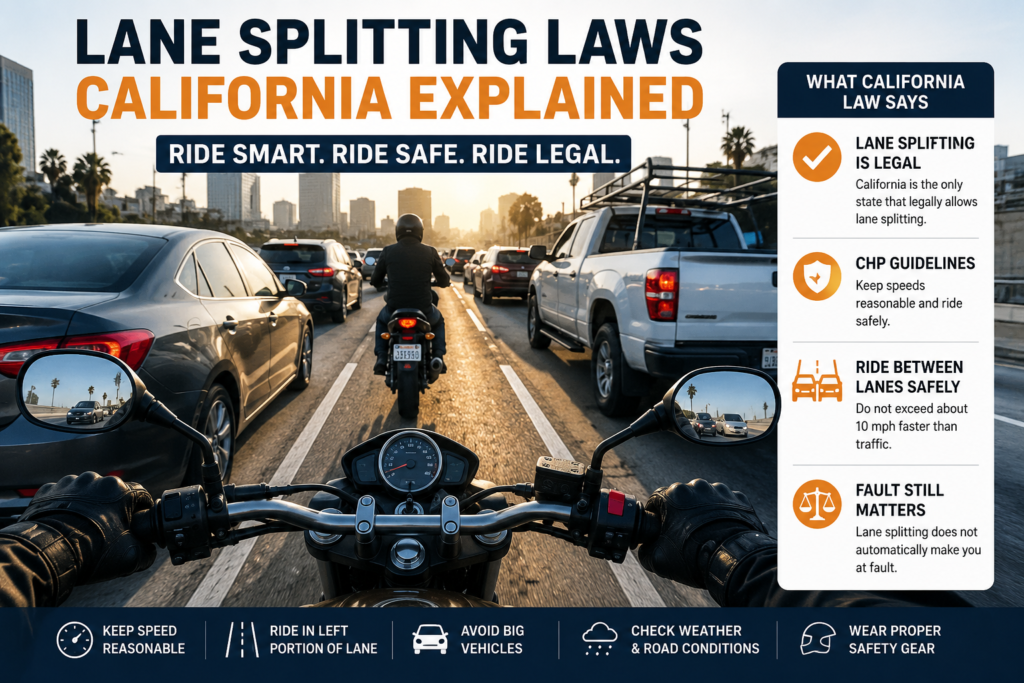
One of the most significant areas where motorcycle accident vs car accident law California diverges is lane splitting. California is the only state in the country that expressly permits motorcycles to split lanes — riding between lanes of traffic moving in the same direction. Car drivers have no equivalent right and no equivalent legal exposure.
For motorcyclists, lane splitting creates a unique legal dimension that simply does not exist in car accident claims. Even when a rider is splitting lanes lawfully and safely, insurers will frequently attempt to use the act of lane splitting as a partial fault argument in any crash that occurs in proximity to a split. The relevant question for comparative negligence purposes is not whether lane splitting was legal — it was — but whether the manner of the split contributed to the specific crash that occurred.
Speed differential between the motorcycle and surrounding traffic, proximity to large vehicles, and behavior during the split are all factors that can become comparative fault arguments even when the other driver’s conduct was the primary cause of the crash. This is a legal dynamic that has no equivalent in car accident claims and requires specific handling by an attorney who understands how these arguments work. Our lane splitting accident lawyer page covers this in detail.
Helmet Laws vs Seatbelt Laws
California requires all motorcycle riders and passengers to wear a DOT-approved helmet under Vehicle Code Section 27803. California also requires car occupants to wear seatbelts. On the surface, these seem like equivalent safety requirements. In personal injury litigation, they function very differently.
California follows what is known as the “seatbelt defense limitation” for car accident claims. Evidence that a car occupant was not wearing a seatbelt cannot be used to reduce their damages in a personal injury claim, even if the failure to wear a seatbelt contributed to injury severity. The California Vehicle Code explicitly prohibits using seatbelt non-use as evidence of comparative fault in civil litigation.
No equivalent protection exists for motorcycle helmet non-use. If a rider was not wearing a DOT-approved helmet and sustained head or facial injuries, an insurer can — and often does — argue that the failure to wear a helmet contributed to the severity of those injuries and should be reflected in the fault percentage. This argument requires medical expert support to hold up, but it is a legitimate comparative negligence argument that has no parallel in car accident litigation involving seatbelts.
This distinction is one of the more significant legal asymmetries in the motorcycle accident vs car accident law California comparison, and it underscores why helmet compliance matters not just for physical safety but for legal protection as well.
Wrongful Death Claims — Motorcycles vs Cars
When a crash is fatal, the legal process shifts to a wrongful death claim under California Code of Civil Procedure Section 377.60. The categories of eligible family members who can bring a wrongful death claim, and the categories of damages they can recover, are the same regardless of whether the vehicle involved was a motorcycle or a car.
What differs is the frequency and severity of fatal outcomes. Motorcycle riders are significantly more likely to die in a crash than car occupants involved in equivalent collisions. This makes wrongful death claims a more common outcome of motorcycle accident litigation than car accident litigation, and it creates specific legal and emotional challenges for families pursuing compensation after losing a loved one on a motorcycle.
Wrongful death damages available to surviving family members include loss of financial support, loss of household services, loss of companionship and consortium, and the deceased’s own medical and funeral expenses. Our wrongful death motorcycle accident page outlines how these claims are handled and what families in San Diego can realistically expect from this process.
How San Diego Courts Handle Motorcycle vs Car Accident Cases
San Diego County sees a substantial volume of motorcycle accident litigation given the region’s year-round riding weather, coastal roads, and high freeway traffic. Local courts, juries, and insurance practices all reflect the patterns that emerge from that volume of cases.
San Diego juries have historically been willing to award meaningful compensation in motorcycle injury cases when liability is clearly established and damages are well-documented. However, they are also susceptible to the same anti-rider bias that affects insurance negotiations — which means how a case is framed and presented matters enormously. A jury that begins with the assumption that a motorcyclist was reckless needs to be shown clear, specific evidence that challenges that assumption before comparative fault percentages will be fair.
Common crash locations in San Diego where motorcycle vs car comparative fault disputes are particularly complex include Downtown San Diego intersections, the freeway corridors through Chula Vista and El Cajon, and the coastal routes through Encinitas and Oceanside. Each of these environments produces distinct crash patterns and distinct comparative fault arguments that local practitioners are familiar with.
If your crash involved a drunk driver, the liability picture is considerably clearer, and the damages available may include punitive components that are not available in standard negligence cases. Our drunk driver motorcycle accident page covers how those cases are handled differently under California law.
Frequently Asked Questions
What is the main difference between motorcycle accident vs car accident law California?
The legal framework — negligence, comparative fault, and available damages — is the same for both. The practical differences lie in motorcycle-specific laws like helmet requirements and lane splitting rules, the broader comparative fault arguments available against riders, the higher injury severity typical of motorcycle crashes, and the implicit bias motorcyclists face from insurers and juries that car drivers generally do not encounter.
Do motorcycle accident claims take longer to resolve than car accident claims in California?
They often do, primarily because motorcycle injuries tend to be more severe. Serious injury cases require more time to reach maximum medical improvement before damages can be fully calculated, more expert involvement to document future losses, and more complex negotiation when insurers aggressively dispute comparative fault. Simple motorcycle accident claims can resolve relatively quickly, but cases involving significant injuries typically take longer than equivalent car accident claims.
Can a motorcyclist recover compensation if they were not wearing a helmet in California?
Yes. California’s pure comparative negligence rule allows recovery regardless of fault percentage. However, not wearing a helmet can be used as a comparative fault argument in cases involving head or facial injuries, which may reduce the amount recovered. The argument requires medical evidence and is not automatically applied — but it is a legal exposure that car drivers not wearing seatbelts do not face in California.
Is lane splitting a factor in determining fault after a motorcycle accident?
Lane splitting itself is legal in California, so the fact that a rider was splitting lanes does not automatically establish fault. What insurers and defense attorneys focus on is the manner of the split — specifically the speed differential relative to surrounding traffic and proximity to larger vehicles. These fact-specific questions can affect the comparative fault analysis even when the split was technically lawful.
Are motorcycle accident settlements larger than car accident settlements in California?
On average, yes — because the injuries involved in motorcycle crashes are typically more severe, medical costs are higher, and the long-term impact on a rider’s life and earning capacity is often greater than in car accident cases with comparable crash speeds. However, settlement amounts depend on the specific facts, the evidence presented, the insurance coverage available, and the skill with which the claim is built and negotiated.
Does California require motorcyclists to carry the same insurance as car drivers?
The minimum liability insurance requirements are the same for both. However, optional coverages like uninsured motorist protection, underinsured motorist coverage, and medical payments coverage are less consistently carried by motorcyclists — which can leave riders with limited recovery options when the at-fault driver is uninsured or underinsured.
Can a motorcyclist be sued for a car accident in California?
Yes. If a motorcyclist’s negligent operation of their motorcycle contributed to a crash that injured a car occupant, the rider can face a civil lawsuit the same way any negligent driver can. California’s comparative fault rules apply to all parties regardless of vehicle type.
How does a wrongful death claim work differently for motorcycle accidents vs car accidents?
The legal process and available damages categories are the same. The practical difference is that fatal outcomes are significantly more common in motorcycle accidents than in car accidents, making wrongful death litigation a more frequent outcome of motorcycle crash cases. Families pursuing these claims face the same legal process but often deal with larger damages given the catastrophic nature of fatal motorcycle crashes.
Conclusion
The motorcycle accident vs car accident law California comparison reveals a legal landscape that is more complex and more demanding for riders than most people realize before they are involved in a crash. The underlying legal rules — negligence, comparative fault, available damages — are the same for both types of claims. But the way those rules are applied, the additional legal requirements that apply only to motorcyclists, the bias riders face in fault assessments, and the severity of injuries that typically result from motorcycle crashes all combine to make motorcycle accident claims a distinctly different legal challenge from car accident claims.
Riders who understand those differences before they speak to an insurance adjuster, before they accept any settlement offer, and before they decide whether to pursue a claim are in a meaningfully stronger position than those who approach a motorcycle claim the same way they would approach a fender-bender in a car. The stakes are higher, the scrutiny is greater, and the need for experienced legal representation is more acute.
Talk to a San Diego Motorcycle Accident Attorney — Free Consultation
If you have been injured in a motorcycle crash in California and want to understand how your claim is likely to be handled differently from a car accident case, our team is here to help. The differences in motorcycle accident vs car accident law California are significant enough that getting the right guidance early can change the outcome of your claim. A free consultation with our San Diego motorcycle accident attorneys costs you nothing and gives you a clear picture of where your claim stands and what it may be worth. Contact us today — there is no fee unless we recover compensation for you.