If you have been hurt in a crash and the insurance adjuster keeps talking about “shared fault” and “fault percentages,” you are probably asking the same question that comes through our office every week: is California a comparative negligence state for motorcycle accidents? The answer is yes — and understanding exactly what that means for your claim is one of the most important things you can do after a crash.
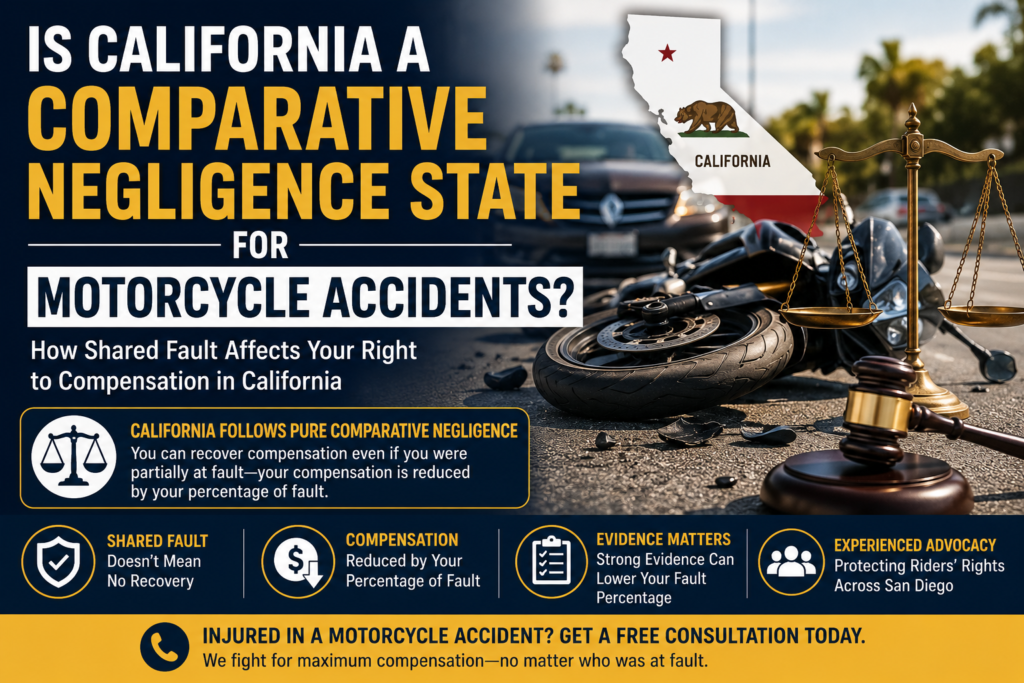
California follows a rule called pure comparative negligence. Under this standard, injured riders can recover compensation even when they share some responsibility for the crash that hurt them. That sounds like good news — and it is — but it also gives insurance companies a built-in reason to push as much fault as possible onto the rider. Every percentage point they shift onto you is a percentage point they do not have to pay.
This guide explains how California’s comparative negligence rule works, how it affects the value of a motorcycle accident claim, and what you can do to protect yourself when fault becomes a fight.
Is California a Comparative Negligence State for Motorcycle Accidents?
Yes. California is a comparative negligence state for motorcycle accidents, and the version California follows is called pure comparative negligence. This means that even if a rider is found partially at fault for a crash, they can still recover compensation. The amount they receive is reduced by their assigned percentage of fault — but there is no threshold that eliminates the right to recover entirely.
The legal foundation for this rule goes back to the California Supreme Court’s 1975 decision in Li v. Yellow Cab Co., which replaced the older contributory negligence doctrine. Under the old rule, being even 1% at fault for an accident completely barred any recovery. The court found that result fundamentally unfair and replaced it with a proportional system. Today, that rule is codified under California Civil Code Section 1714, which establishes that each person bears responsibility for harm caused by their own failure to exercise ordinary care.
For a broader overview of how California law governs motorcycle accidents, our California motorcycle accident law page provides helpful background alongside this guide.
Why This Rule Matters to Injured Riders
Many riders walk away from legitimate claims because they assume being partly at fault ends the conversation. It does not. Under California’s pure comparative negligence standard, the only scenario where you recover nothing is if you are found 100% responsible for the crash. Short of that, you have a claim worth pursuing. Understanding this distinction before you speak to an insurance adjuster can be the difference between recovering what you are owed and walking away from compensation you are entitled to.
What Is Comparative Negligence Under California Law?
Comparative negligence is a legal framework for dividing financial responsibility among everyone whose actions contributed to causing an accident. Instead of asking who caused the crash, California law asks how much each party contributed — and expresses that answer as a percentage.
After a motorcycle accident, those percentages are determined by reviewing the full body of available evidence. Police reports, photos from the scene, traffic camera footage, eyewitness accounts, and accident reconstruction analysis all feed into that assessment. Each party involved is then assigned a percentage of fault that adds up to 100%.
Here is a simple example. A driver runs a stop sign and strikes a motorcyclist who was riding ten miles per hour over the speed limit. The driver might be found 80% at fault for running the stop sign, and the rider 20% at fault for speeding. If the rider’s total damages are $150,000, their recoverable amount is reduced to $120,000 — but they still collect that remaining 80%. This kind of fact pattern comes up regularly in cases like an intersection motorcycle accident or a left-turn collision.
Pure Comparative Negligence vs Modified Comparative Negligence
Not every state handles shared fault the same way, and the differences are significant enough to dramatically change what an injured rider can recover depending on where the crash occurred.
Pure comparative negligence — which California uses — allows an injured party to recover damages regardless of how high their fault percentage is. Even a rider found 90% responsible can still recover 10% of their proven damages. There is no cutoff.
Modified comparative negligence, used in most other states, imposes a hard fault ceiling. Once an injured person reaches 50% or 51% fault — depending on the state — they recover nothing at all, no matter how serious their injuries are.
A small number of states still use contributory negligence, the standard California abandoned in 1975. Under that rule, being even 1% at fault eliminates the right to recover entirely.
California’s pure comparative negligence standard is genuinely more protective for injured riders. In cases involving catastrophic outcomes — such as a spinal cord injury, a traumatic brain injury, or permanent disability — that protection can represent hundreds of thousands of dollars that a rider in a modified comparative negligence state would lose entirely.
How Comparative Negligence Affects Motorcycle Accident Claims
Once you understand that California is a comparative negligence state for motorcycle accidents, the next question is what that actually means for the money in your case.
Every category of loss you are entitled to claim — medical bills, future treatment, lost wages, lost earning capacity, pain and suffering, emotional distress, property damage — gets totaled into a gross damages figure. That number is then reduced by your assigned fault percentage to produce your actual recoverable compensation.
On a $300,000 claim, being found 20% at fault costs you $60,000. Being pushed to 40% costs you $120,000. The stakes behind each percentage point are enormous — and insurance companies understand this math far better than most injured riders do at the time of a crash. This is why comparative negligence sits at the center of nearly every contested motorcycle accident settlement negotiation.
Adjusters are trained to find anything that can be framed as rider error — lane position, speed, visibility, gear, reaction time. Statements made in a recorded interview, comments at the scene, and gaps in medical treatment can all become supporting material for a comparative negligence argument later. This is one of the core reasons why how you handle an motorcycle accident insurance claim in the days immediately following a crash has such a direct impact on the final outcome.
Common Situations Where Riders Share Fault
Comparative fault arguments do not always involve obvious or extreme wrongdoing. Some of the most common scenarios where insurers try to assign partial fault to a motorcyclist involve decisions most riders would not think twice about in the moment.
- Speeding — Even a few miles per hour over the limit gives an adjuster something to work with. If they can argue that lower speed would have provided more stopping distance or reaction time, they will make that argument.
- Following too closely — Tailgating is a frequent basis for shared-fault arguments, particularly in rear-end motorcycle accidents, even when the lead vehicle stopped suddenly or without warning.
- Riding in a blind spot — Spending extended time in another vehicle’s blind spot before a lane-change collision is routinely raised as a partial fault argument, even when the driver never checked their mirrors.
- Signal failures — Failing to use a turn signal before a lane change or turn, even in situations where the other driver’s actions were the primary cause of the crash.
- Distracted riding — Any behavior an insurer can frame as inattentive, including adjusting a GPS mount or interacting with equipment while moving.
- Motorcycle modifications — Non-stock exhaust, custom lighting, or handlebar changes may be used to argue the motorcycle was harder for other drivers to see or hear.
None of these factors automatically make a rider primarily responsible for a crash. Many of these arguments don’t survive close scrutiny once proper evidence is examined. But riders who don’t understand why these arguments are being raised — or how to counter them — are at a real disadvantage from the start.
Lane Splitting and Comparative Negligence
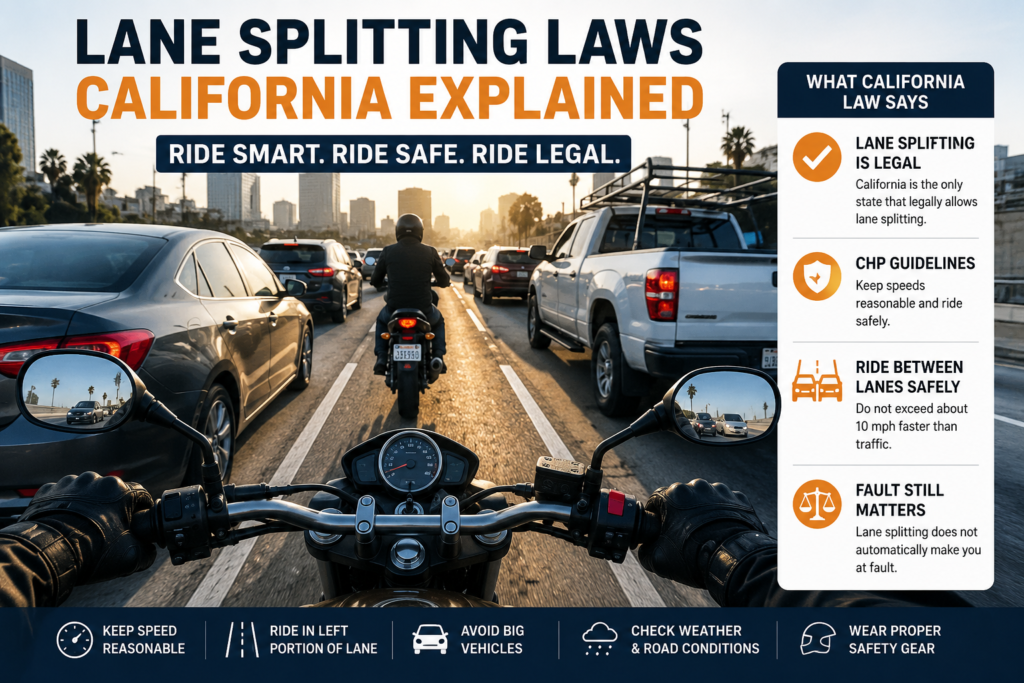
California was the first state to formally legalize lane splitting, but that legal status does not remove the practice from comparative negligence analysis. Insurance companies regularly attempt to use lane splitting as a partial fault argument even in crashes where the rider was splitting safely and within the law.
The argument insurers typically construct does not focus on whether lane splitting was permitted. It focuses on how it was executed. Speed differential between the motorcycle and surrounding traffic is almost always the centerpiece of these arguments. A rider moving significantly faster than the flow of traffic while splitting — even within technical legal bounds — may face a stronger comparative fault argument than one moving only slightly faster than nearby vehicles.
The California Highway Patrol previously published lane-splitting safety guidelines that emphasized modest speed differentials and extra caution near large vehicles. While those guidelines are no longer formally enforced, defense attorneys and insurance adjusters frequently reference them as a benchmark for reasonable lane-splitting behavior when building a comparative fault position.
The key legal distinction is between lane splitting being legal and lane splitting being performed in a manner that contributed to a specific crash. Comparative negligence analysis asks the second question, not the first. Our lane splitting accident lawyer page explains how these cases are typically evaluated in more detail.
Helmet Law and Comparative Negligence
California requires all motorcycle riders and passengers to wear a DOT-approved helmet under Vehicle Code Section 27803. Helmet use intersects with comparative negligence in a specific and limited way that is worth understanding clearly.
A missing or non-compliant helmet does not make a rider responsible for causing a crash. Causation and injury severity are separate issues under California law. A driver who makes an illegal left turn in front of a motorcyclist is still the primary cause of that collision regardless of what the rider was wearing. However, California’s comparative negligence framework allows fault to be apportioned based on conduct that worsened the resulting injuries — not just conduct that triggered the initial impact.
In practice, this means an insurer may argue that riding without a proper helmet contributed to the severity of head or facial injuries — and that this should factor into the fault percentage. This argument requires medical evidence to support it. The insurer needs expert testimony establishing that a properly fitted, DOT-approved helmet would have meaningfully reduced the specific injuries sustained. It is not something they can simply assert, and these arguments are often far weaker than they are initially presented.
In cases where a rider’s most significant injuries involved road rash, broken bones, or internal injuries unrelated to head trauma, the helmet argument has little to no relevance to the damages calculation at all.
How Insurance Companies Use Comparative Negligence
Understanding that California is a comparative negligence state for motorcycle accidents makes it much easier to recognize the specific tactics insurers use to exploit that rule against injured riders.
The Early Recorded Statement Call
Adjusters often call within 24 to 48 hours of a crash — before the rider has spoken with an attorney, received a complete medical evaluation, or reviewed any crash evidence. Questions are carefully worded to prompt statements about speed, awareness, and visibility that can later support a partial fault argument. You are not legally required to give a recorded statement to the other driver’s insurance company.
Presenting Fault as Fixed
Adjusters commonly present their internal fault assessment as a settled determination — “our investigation found you were 35% at fault” — when it is actually an opening negotiating position based on incomplete early evidence. Many riders accept this framing without realizing it can be challenged with proper documentation.
Using Litigation as a Threat
Some adjusters imply that going to court risks a higher fault assignment, hoping to push riders toward a quick, undervalued settlement rather than letting a fully documented claim develop. In reality, fault percentages are determined by evidence — not by an insurer’s internal opinion — and well-prepared claims regularly achieve substantially lower fault assignments than what was initially proposed. This tactic is particularly common when a claim is moving toward a formal motorcycle accident lawsuit.
Evidence That Can Reduce Your Percentage of Fault
Because fault percentages translate directly into dollars, building strong evidence early is one of the most effective ways to protect your recovery. The most valuable categories of evidence in motorcycle accident comparative negligence disputes include:
- Scene photographs and video — Skid marks, debris patterns, vehicle positions, and road conditions document exactly how a crash unfolded. This evidence disappears quickly as roads are cleaned and vehicles are moved.
- Surveillance and traffic camera footage — Footage from nearby businesses and intersection cameras is frequently overwritten within 24 to 72 hours. Acting quickly to preserve it matters.
- Cell phone records — These can establish whether the other driver was distracted at the moment of impact, particularly in cases involving a hit-and-run or a driver who ran a red light.
- Eyewitness statements — Accounts gathered close to the time of the crash carry more weight than statements collected weeks later after memories have faded.
- Accident reconstruction analysis — In heavily disputed cases, a reconstruction expert can use physics, vehicle damage, and road data to build a precise model of how the collision occurred.
- Motorcycle maintenance records — Service documentation helps rule out mechanical failure as a contributing cause, which insurers occasionally raise in cases where other arguments are weak.
Knowing what to gather — and doing it quickly — is something our what to do after a motorcycle accident guide covers in practical detail. There are also strict deadlines for pursuing a claim in California, so understanding how long you have to file a motorcycle accident claim is equally important.
Examples of Comparative Negligence in Motorcycle Accidents
These are illustrative scenarios — not real cases — but they reflect the fact patterns and fault arguments that come up regularly in California motorcycle claims.
Rear-End Collision at a Red Light
A rider stopped at a red light is rear-ended by a driver looking at their phone. The rider’s brake light was functioning. There is almost no credible comparative fault argument against the rider here. The driver bears essentially all responsibility, and the rider’s recovery is unlikely to face any meaningful fault reduction.
Left-Turn Collision With a Speed Dispute
A rider traveling through a green light is struck by a driver making an illegal left turn. The driver claims the rider was speeding. Speed data is inconclusive. Here the comparative negligence fight centers entirely on the speed question, and accident reconstruction becomes the most critical piece of evidence. This is one of the most common patterns in left-turn motorcycle accidents, and the final fault split can vary widely depending on what the evidence supports.
Lane-Split Collision on the Freeway
A rider splitting lanes during slow freeway traffic is struck by a car that changes lanes without signaling. The insurer argues the speed differential was excessive. A witness confirms the car never signaled. Fault may be shared here — but the proportions depend heavily on specific speed data and the strength of the witness account.
Highway Merge Involving a Commercial Truck
A rider is struck by a truck driver who failed to check mirrors during a freeway merge. The rider had been in the truck’s blind spot before impact. An insurer raises a blind-spot argument against the rider. Whether that argument succeeds depends on how long the rider was in the blind spot and whether they had a reasonable opportunity to clear it. These questions come up regularly in both highway accidents and commercial truck collisions.
How Comparative Negligence Works in San Diego Motorcycle Cases
San Diego’s combination of urban corridors, coastal highways, and heavy commuter traffic creates recurring crash patterns — and with them, recurring comparative negligence arguments that local insurers are well prepared to deploy.
In the city’s urban core, areas like Downtown San Diego see frequent left-turn collisions at controlled intersections. The comparative negligence dispute in these cases almost always centers on the rider’s speed approaching the intersection and their visibility to the turning driver in the seconds before impact.
In suburban communities like El Cajon, Chula Vista, and Santee, higher speed limits and wider arterial roads shift comparative fault arguments toward speed choices, following distances, and lane-positioning decisions on roads where traffic moves faster.
Along the county’s coastal routes through areas like Encinitas and Oceanside, road hazard arguments occasionally surface — situations where a rider’s line or speed through a curve or near a construction zone is challenged as contributing to the severity of a collision.
A San Diego motorcycle injury attorney who regularly handles these cases knows which comparative fault arguments have evidentiary support and which ones are leverage tactics designed to reduce a payout. That distinction directly affects how fault percentages are negotiated in local claims.
Frequently Asked Questions
Is California a comparative negligence state for motorcycle accidents?
Yes. California is a comparative negligence state for motorcycle accidents and follows the pure comparative negligence standard. An injured rider can recover compensation regardless of their percentage of fault, as long as it is below 100%. Their damages are reduced proportionally by their share of responsibility.
Can I still recover compensation if I was 70% at fault for my motorcycle accident?
Yes. Under California’s pure comparative negligence rule, you would still recover 30% of your total proven damages even if found 70% at fault. There is no fault threshold that eliminates your right to recover, which is what separates California from most other states.
Who decides my percentage of fault after a motorcycle accident in California?
Initially, insurance companies assign fault percentages internally based on available evidence — police reports, photos, and witness statements. These are negotiating positions, not legal determinations. If a settlement is not reached, a jury or judge makes the final fault determination at trial based on all presented evidence.
Does lane splitting automatically mean I am partially at fault?
No. Lane splitting is legal in California and does not automatically create shared fault. Insurers may argue that the manner in which you were lane splitting — particularly your speed relative to surrounding traffic — contributed to the crash, but the legality of the maneuver itself is not at issue.
Will not wearing a helmet affect my motorcycle accident claim in California?
California requires DOT-approved helmets, and a missing or non-compliant helmet can potentially affect the damages portion of your claim if head or facial injuries are involved. It does not, however, make a rider responsible for causing the underlying crash. The argument also requires medical evidence to hold up.
How is California’s comparative negligence different from other states?
Most states use modified comparative negligence, which bars any recovery once the injured person reaches 50% or 51% fault. California has no such cutoff. A rider found 80% at fault in California still recovers 20% of their proven damages. In a modified comparative negligence state, that same rider recovers nothing.
Can insurance companies change my fault percentage during negotiations?
Yes. Initial fault assessments are internal positions based on early, often incomplete information. Fault percentages shift regularly when additional evidence is introduced, witnesses are identified, or reconstruction analysis is presented. An initial 40% fault assignment is not necessarily the final number.
Do I need a motorcycle accident attorney if comparative negligence is being argued against me?
It is not legally required, but it is strongly advisable. Comparative negligence disputes are where the financial difference between represented and unrepresented riders is most significant. Every percentage point of fault that gets argued down translates directly into additional compensation. An experienced motorcycle injury attorney knows how to gather and present the evidence that challenges inflated fault percentages effectively.
Conclusion
California is a comparative negligence state for motorcycle accidents — and that rule cuts both ways. It gives injured riders the right to pursue compensation even when they share some responsibility for a crash, which is far more equitable than the all-or-nothing standards used in many other states. But it also gives insurance companies a built-in mechanism for reducing their financial exposure by arguing that a higher percentage of fault belongs to the rider.
The outcome in any given claim depends on evidence, preparation, and knowing how to push back against fault assessments that do not reflect what actually happened. Riders who understand how pure comparative negligence works — and who take steps to preserve evidence and get experienced legal representation early — consistently achieve better results than those who accept an insurer’s initial fault framing without question.
Understanding what you are up against is the starting point. What happens next depends on how well that knowledge is put to use.
Talk to a San Diego Motorcycle Accident Attorney — Free Consultation
If an insurance company is using comparative negligence to reduce or deny your claim, you have every right to challenge it — and legal support makes a measurable difference in how that challenge plays out. A free consultation with our San Diego motorcycle accident team costs you nothing and gives you a clear picture of where your claim stands, what your fault percentage should realistically look like, and what your case may be worth. Contact us today — there is no fee unless we recover compensation for you.