One of the first questions injured riders ask after a crash is how much their case might be worth. Motorcycle accident settlement amounts in California vary significantly from one case to the next — and understanding what drives that variation is one of the most useful things you can do before you start negotiating with an insurance company. Some claims settle for tens of thousands of dollars. Others reach into the millions. The difference almost always comes down to the same core factors, and knowing what those factors are puts you in a far stronger position from the start.
Motorcycle accident settlement amounts in California are shaped by injury severity, available insurance coverage, fault allocation, and the quality of evidence supporting the claim. None of these factors work in isolation. They combine to produce a number that either reflects the full scope of what a rider has lost — or falls short of it because key documentation was missing, a fault percentage was accepted without challenge, or an early settlement offer was taken before the full picture of injuries was known.
This guide covers every major factor that affects what a California motorcycle accident settlement is worth, what mistakes reduce those amounts, and what you can do to protect the value of your claim. For broader context on how California law governs these cases, our California motorcycle accident law page provides essential background.
What Determines Motorcycle Accident Settlement Amounts in California?
Motorcycle accident settlement amounts in California are not produced by a formula. They are the result of how thoroughly losses are documented, how fault is allocated between the parties, and how effectively the full impact of the injury is communicated to an insurer or jury. That said, the factors that drive these amounts are consistent across almost every claim.
Severity of Your Injuries
This is the single largest driver of settlement value in any motorcycle accident case. Motorcycle crashes produce injuries that are significantly more serious than those in car accidents at equivalent speeds, because riders have no structural protection around them. The more severe the injury and the longer and more complex the recovery, the higher the settlement value. A rider who breaks a wrist and returns to work within eight weeks has a very different claim than one who sustains a spinal cord injury requiring lifelong care.
According to the National Highway Traffic Safety Administration, motorcyclists are significantly more likely to be killed or seriously injured in a crash than occupants of enclosed passenger vehicles. That injury disparity translates directly into higher average settlement values for motorcycle cases compared to car accident cases involving similar crash speeds.
Total Medical Costs — Past and Future
Medical expenses form the financial foundation of every motorcycle injury claim. Past medical costs — every bill from emergency transport through the date of settlement — are documented and relatively straightforward to calculate. Future medical costs are often the largest single component of a serious motorcycle accident settlement amount in California, and they require expert testimony to establish accurately. Life care planners and medical economists project the cost of ongoing treatment, surgeries, rehabilitation, medications, and assistive equipment over the rider’s remaining lifetime. Without that expert work, future medical costs are either guessed at or ignored entirely — both of which reduce the settlement significantly.
Lost Income and Earning Capacity
Past lost wages — income you were unable to earn during your recovery period — are recoverable in full. Future lost earning capacity is often far more significant, particularly in cases involving permanent or long-term injuries. A rider in their thirties who sustains a permanent disability affecting their ability to work has potentially decades of reduced earning capacity to account for. Calculating that loss accurately requires vocational experts and economists. Without them, insurers simply do not accept the numbers a rider puts forward on their own.
Fault and Comparative Negligence
California’s pure comparative negligence rule reduces your settlement amount by whatever percentage of fault is assigned to you. A $400,000 claim where the rider is found 25% at fault produces a $300,000 recovery. A 10% fault reduction on that same claim produces $360,000. Every percentage point matters financially, which is why how fault is established and negotiated is just as important to motorcycle accident settlement amounts in California as documenting the full value of damages. Our detailed guide on motorcycle accident claims in San Diego covers how this negotiation process works in practice.
Available Insurance Coverage
Even the strongest claim is practically constrained by the insurance coverage available to pay it. California requires minimum liability limits of $15,000 per person — a number that is inadequate for virtually any serious motorcycle injury. When the at-fault driver carries only minimum limits, your recovery from their policy is capped at that amount regardless of your actual damages, unless you have underinsured motorist coverage through your own policy to bridge the gap.
Quality and Completeness of Evidence
Claims supported by early-gathered, well-organized evidence settle for more and settle faster than claims built on thin documentation. Police reports, crash scene photographs, surveillance footage, eyewitness accounts, medical records showing consistent treatment, and expert accident reconstruction all contribute to a clearer liability and damages picture that insurers cannot easily dispute.
Types of Damages That Make Up Motorcycle Accident Settlement Amounts in California
When we talk about what a settlement is worth, we are really talking about the total of all the different categories of loss a rider is entitled to recover. California law recognizes two broad categories: economic damages and non-economic damages.
Economic Damages
Economic damages are financial losses that can be calculated with relative precision:
- Past medical expenses — every bill from the crash date to settlement
- Future medical expenses — projected lifetime treatment costs calculated with medical expert input
- Past lost wages — income lost during the recovery period
- Future lost earning capacity — long-term reduction in the ability to earn income
- Property damage — repair or replacement value of the motorcycle and riding gear
- Out-of-pocket expenses — transportation to appointments, home care, and related costs
Non-Economic Damages
Non-economic damages compensate for losses that do not come with a bill but are real and significant. They include pain and suffering, emotional distress, loss of enjoyment of life, and loss of consortium. Non-economic damages are often where the largest variation in motorcycle accident settlement amounts in California occurs. Insurers work hard to minimize these numbers, while an experienced advocate builds a concrete, evidence-supported case for their full value.
Riders who develop post-traumatic stress disorder after a crash frequently have substantial non-economic damages that early insurer offers drastically undervalue — precisely because psychological injuries are invisible in a way that a broken bone is not.
Punitive Damages
In cases involving particularly reckless conduct — a crash caused by a drunk driver, for example — California law allows punitive damages on top of compensatory damages. These are not available in every case and require a higher evidentiary threshold, but when applicable they can substantially increase the total recovery beyond what economic and non-economic damages alone would produce.
How Serious Injuries Affect Motorcycle Accident Settlement Amounts in California
The injury is the anchor of the settlement value. Here is how the most common serious motorcycle accident injuries affect what a claim may be worth.
Traumatic Brain Injuries
Traumatic brain injuries range from mild concussions to severe TBIs that permanently alter cognition, memory, and physical function. Severe TBI cases produce some of the highest motorcycle accident settlement amounts in California because of the combination of lifelong medical costs, total or near-total loss of earning capacity, and profound impact on quality of life. These cases require neurological experts, neuropsychological testing, and life care planners — and they are among the most aggressively fought by insurance companies for exactly that reason.
Spinal Cord Injuries
Spinal cord injuries resulting in partial or complete paralysis carry some of the largest settlement values of any personal injury case type. Lifetime medical costs for a complete spinal cord injury can reach into the millions when accounting for ongoing care, adaptive equipment, home modifications, and decades of lost income. These cases require extensive expert involvement and rarely settle quickly — but when properly documented and aggressively pursued, the recoveries reflect the true scope of what the rider has lost.
Road Rash
Severe road rash is frequently underestimated. Deep abrasions that damage tissue beneath the skin can require multiple surgeries, skin grafting, and months of wound care. Permanent scarring — particularly facial scarring — carries significant non-economic damage value because of its lasting, visible impact. Road rash cases involving significant disfigurement settle for considerably more than cases where abrasions healed without permanent marks.
Broken Bones
Fractures vary enormously in severity. A clean break that heals fully within a few months produces a different settlement value than a comminuted fracture requiring surgical fixation, hardware implantation, and extended rehabilitation. Fractures that lead to chronic pain, limited range of motion, or post-traumatic arthritis carry higher values because they represent ongoing, not just past, loss.
Internal Injuries
Internal injuries — organ damage, internal bleeding, pneumothorax — can be life-threatening and frequently require emergency surgery and extended hospitalization. The combination of high acute medical costs and potential long-term complications makes internal injury cases among the more significant in terms of settlement value.
How Crash Type Affects Motorcycle Accident Settlement Amounts in California
The type of crash shapes both how fault is argued and the pattern of injuries involved — both of which directly affect motorcycle accident settlement amounts in California.
Left-Turn Collisions
Left-turn crashes — where a driver turns across a rider’s path — are among the most common and most serious motorcycle crash types. Liability tends to favor the rider strongly when they had the right of way, though insurers routinely raise speed arguments to assign partial fault. Left-turn motorcycle accident cases can carry high settlement values when injuries are serious and the fault picture is clear.
Rear-End Collisions
When a rider is rear-ended, liability is typically straightforward — the following vehicle is presumed at fault. Rear-end motorcycle accidents can produce severe spinal and brain injuries because of the sudden forward momentum transfer, and settlement values reflect that injury severity when it is well-documented.
Head-On Collisions
Head-on collisions are among the most lethal crash types for motorcyclists. When survivable, they typically produce catastrophic injuries with correspondingly large settlement values — or they result in wrongful death claims handled by surviving family members.
Lane-Splitting Crashes
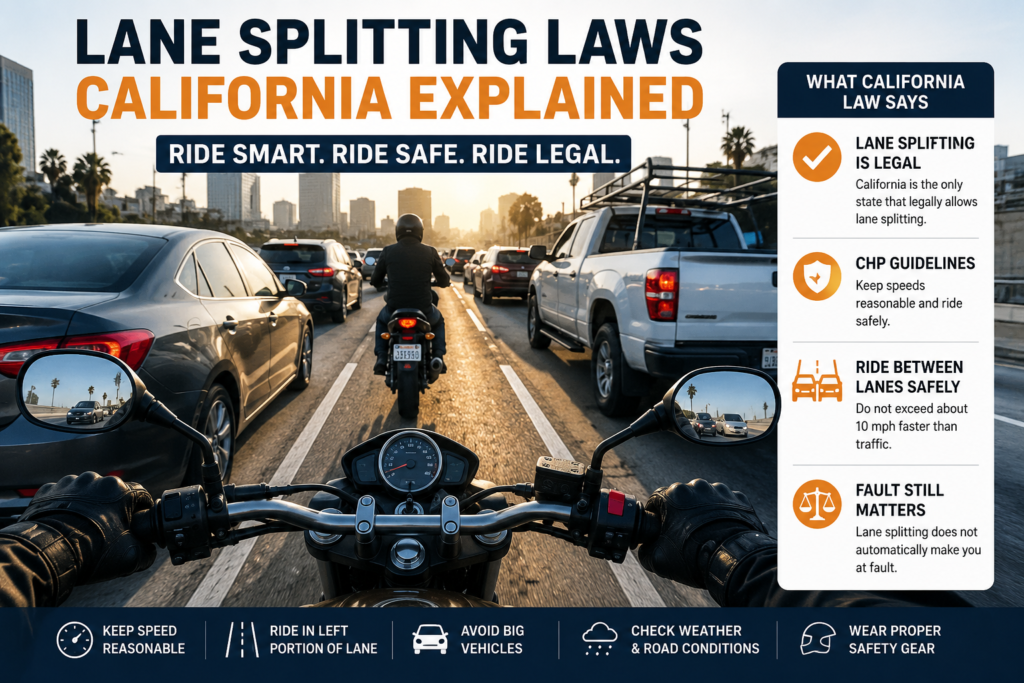
Lane-splitting crashes introduce comparative fault complexity that can reduce settlement values depending on how the split was executed. Even when the other driver made the primary error, insurers argue that speed differential during the split contributed to the crash. Our lane splitting accident lawyer page covers how these arguments are handled and what evidence matters most.
Hit-and-Run Crashes
Hit-and-run accidents present unique recovery challenges when the at-fault driver cannot be identified. In these situations, the rider’s own uninsured motorist coverage becomes the primary source of compensation — which is why carrying adequate UM coverage is one of the most important financial protections a rider can have.
Commercial Truck Crashes
Crashes involving commercial trucks often produce higher motorcycle accident settlement amounts in California for two reasons: injuries are typically catastrophic, and commercial trucking companies carry substantially higher insurance limits than individual car drivers. Federal trucking regulations, driver hour logs, and vehicle maintenance records also create additional avenues for establishing liability.
How Insurance Coverage Limits Affect Motorcycle Accident Settlement Amounts in California
Understanding motorcycle accident settlement amounts in California requires understanding one fundamental constraint: recovery is practically limited by the available insurance coverage unless you can reach the at-fault party’s personal assets through a court judgment.
California’s minimum liability limits — $15,000 per person — are insufficient for any serious motorcycle injury. When the at-fault driver carries only minimum limits, that is the cap on what their policy pays regardless of your actual damages. This is where your own uninsured and underinsured motorist coverage becomes critical. If you carry underinsured motorist coverage with limits of $100,000, and the at-fault driver’s policy pays its $15,000 limit, your coverage can contribute an additional $85,000 toward your total recovery.
Under California Insurance Code Section 11580.2, insurers are required to offer uninsured motorist coverage to all policyholders. Riders who waive this coverage — often without fully understanding what they are giving up — are taking a significant financial risk that can severely limit motorcycle accident settlement amounts in California when the at-fault driver is uninsured or underinsured. Our motorcycle accident insurance claim page covers how to navigate these coverage layers in detail.
How Comparative Negligence Reduces Motorcycle Accident Settlement Amounts in California
Comparative negligence is one of the most financially consequential issues in any motorcycle accident case. Insurance companies argue comparative fault more aggressively against riders than against car drivers — and every percentage point they successfully shift onto the rider directly reduces the settlement amount.
Consider a claim with total documented damages of $250,000. If the insurer initially assigns the rider 30% fault, the effective settlement offer is $175,000. Pushing that fault percentage down to 10% through evidence and negotiation increases the recovery to $225,000 — a $50,000 improvement achieved purely by challenging the fault percentage, without changing a single underlying damage figure.
This is why building a strong comparative negligence defense is not a secondary concern — it is often the most financially impactful part of the entire case. Riders who accept an insurer’s initial fault assessment without challenge are frequently leaving significant money behind. Motorcycle accident settlement amounts in California are directly tied to how effectively the fault picture is contested.
Mistakes That Reduce Motorcycle Accident Settlement Amounts in California
Understanding what drives motorcycle accident settlement amounts in California also means understanding what reduces them. These are the most common mistakes that cost injured riders money.
Giving a Recorded Statement Without Legal Guidance
Adjusters call quickly after a crash hoping to get a recorded statement before the rider has spoken with an attorney. These calls are designed to produce statements about speed, awareness, and visibility that can later support a higher fault assignment. You are not legally required to give a recorded statement to the other driver’s insurance company.
Accepting an Early Settlement Offer
Early offers arrive before the full extent of injuries is known. Accepting one closes the case permanently. Riders who settle what appears to be a soft tissue injury that later turns out to involve nerve damage or a herniated disc have no legal recourse after signing a release. Motorcycle accident settlement amounts in California are always lower when a rider settles before reaching maximum medical improvement.
Gaps in Medical Treatment
Periods where a rider stopped attending medical appointments or physical therapy are used by insurers to argue that injuries were not as serious as claimed. Consistent, documented medical care from the date of the crash through maximum medical improvement is one of the single most important things a rider can do to protect their settlement value.
Poor Documentation
Medical bills, pay stubs showing missed work, photographs of injuries throughout the healing process, and records of every out-of-pocket expense all contribute to the documented value of a claim. Evidence that is not preserved cannot be used later. Our what to do after a motorcycle accident guide covers exactly what to document and when.
Posting on Social Media
Photos and comments posted during an active claim period are regularly reviewed by insurance defense teams. A single photo that appears inconsistent with the severity of claimed injuries can be used to challenge the credibility of the entire claim and reduce motorcycle accident settlement amounts in California significantly.
How an Attorney Affects Motorcycle Accident Settlement Amounts in California
Represented claimants consistently recover more than unrepresented ones — even after attorney fees are accounted for. An experienced motorcycle injury attorney knows the full value of a claim including future damages that injured riders frequently overlook. They know how to gather and present evidence that challenges inflated comparative fault percentages. They recognize early settlement tactics and know when an offer is a lowball number designed to exploit immediate financial pressure.
Attorneys also bring access to the expert networks — medical specialists, accident reconstruction analysts, life care planners, and vocational experts — that are essential for properly documenting serious injury claims. Without those experts, insurers know a claim cannot be fully proven at trial, and they price their settlement offers accordingly.
If your case cannot be resolved fairly through negotiation, filing a formal motorcycle accident lawsuit creates the litigation pressure and court deadlines that frequently produce better settlement outcomes than pre-litigation negotiation alone. Motorcycle accident settlement amounts in California are consistently higher when an insurer knows the rider’s attorney is genuinely prepared to go to trial.
California also imposes strict deadlines for filing personal injury claims. Understanding how long you have to file a motorcycle accident claim is essential — missing the statute of limitations eliminates your right to pursue any settlement at all, regardless of how strong your case might have been.
Motorcycle Accident Settlement Amounts in California for Wrongful Death Cases
When a motorcycle crash is fatal, the claim shifts to a wrongful death action under California Code of Civil Procedure Section 377.60. Surviving family members can pursue compensation for loss of financial support, loss of household services, loss of companionship, and the deceased’s own medical and funeral expenses.
Wrongful death motorcycle accident settlement amounts in California tend to be among the largest personal injury recoveries because fatal crash cases typically involve younger victims with decades of lost earning potential, combined with the devastating non-economic losses experienced by surviving spouses and children. Our wrongful death motorcycle accident page covers how these claims are handled and what families in San Diego can realistically expect from this process.
How San Diego-Specific Factors Affect Settlement Amounts
Motorcycle accident settlement amounts in California are also shaped by local factors — including where in the state the crash occurred, which insurer is involved, and how local juries have historically evaluated similar cases.
San Diego County sees a high volume of motorcycle accident litigation given the region’s year-round riding weather, coastal roads, and busy freeway corridors. Local juries have shown willingness to award fair compensation in motorcycle injury cases when liability is clearly established and damages are well-documented. However, anti-rider bias remains a factor, and how a case is framed and presented in a San Diego courtroom matters as much as the underlying evidence.
Common crash locations in San Diego where settlement disputes are particularly complex include areas around Downtown San Diego, the freeway corridors through Chula Vista and El Cajon, and the coastal routes through Encinitas and Oceanside. Each environment produces distinct crash patterns and distinct insurer arguments that experienced local practitioners know how to handle.
Frequently Asked Questions
What are typical motorcycle accident settlement amounts in California?
Motorcycle accident settlement amounts in California vary too widely for a meaningful average to be useful. Minor injury claims may settle for a few thousand dollars. Catastrophic injury cases — spinal cord injuries, severe TBIs, permanent disability — can reach seven figures or more. The only number that matters is the one that accurately reflects your specific losses, not an average from a case with completely different facts.
How is pain and suffering calculated in a California motorcycle accident settlement?
There is no fixed formula. Some practitioners apply a multiplier to total medical costs — typically between 1.5 and 5 depending on injury severity. Others use a per diem method that assigns a daily dollar value to ongoing pain and suffering. Neither method is legally mandated. The actual value depends on how thoroughly the impact on the rider’s daily life is documented and how strong the overall liability case is.
Can I still get a settlement if I was partly at fault for the crash?
Yes. California’s pure comparative negligence rule allows recovery at any fault percentage below 100%. Your settlement amount is reduced proportionally by your fault share, but you are not barred from recovering compensation simply because you contributed to the crash in some way.
Does not wearing a helmet reduce motorcycle accident settlement amounts in California?
It can, if head or facial injuries are involved. An insurer may argue that riding without a DOT-approved helmet contributed to the severity of those injuries — a comparative negligence argument that requires medical evidence to support. For injuries unrelated to head protection, helmet use is not relevant to the settlement calculation.
How long do motorcycle accident settlements take in California?
Simple claims with clear liability can resolve in a few months. Serious injury cases typically take a year or more because reaching maximum medical improvement — the point where future damages can be accurately projected — takes time. Cases that proceed to trial can take several years from crash to verdict. Settling before maximum medical improvement almost always reduces the final recovery.
What if the at-fault driver has no insurance?
Your own uninsured motorist coverage becomes the primary source of recovery. If you do not carry that coverage, options are limited to pursuing the at-fault driver’s personal assets through litigation — which is often impractical. Motorcycle accident settlement amounts in California are severely constrained in cases where the at-fault driver is uninsured and the rider lacks UM coverage.
Do most motorcycle accident cases settle or go to trial in California?
The vast majority settle before trial. However, filing a lawsuit is sometimes necessary to create the negotiating pressure and legal deadlines that produce fair settlement offers. Many cases that are filed as lawsuits settle before the trial date. Having an attorney who is prepared to go to trial — rather than one who settles everything quickly for whatever is offered — typically results in higher motorcycle accident settlement amounts in California.
Conclusion
Motorcycle accident settlement amounts in California are not fixed numbers produced by a formula. They are the result of how thoroughly damages are documented, how aggressively comparative fault is challenged, how well future losses are calculated and presented, and how effectively the full impact of the injury is communicated to an insurer or jury. Riders who understand these dynamics before engaging with the claims process are consistently better positioned than those who rely on an insurer’s first offer and assume it reflects fair value.
The goal of any settlement is not to close the claim quickly — it is to recover compensation that genuinely reflects everything the crash cost you. Motorcycle accident settlement amounts in California that achieve that goal require patience, thorough documentation, and legal representation that understands both the law and the tactics being used against you.
Talk to a San Diego Motorcycle Accident Attorney — Free Consultation
If you have been injured in a motorcycle crash and want to understand what your motorcycle accident settlement amount in California may realistically be worth, our San Diego team is ready to help. A free consultation costs you nothing and gives you a clear, honest picture of your claim’s value and the steps required to protect it. Contact us today — there is no fee unless we recover compensation for you.